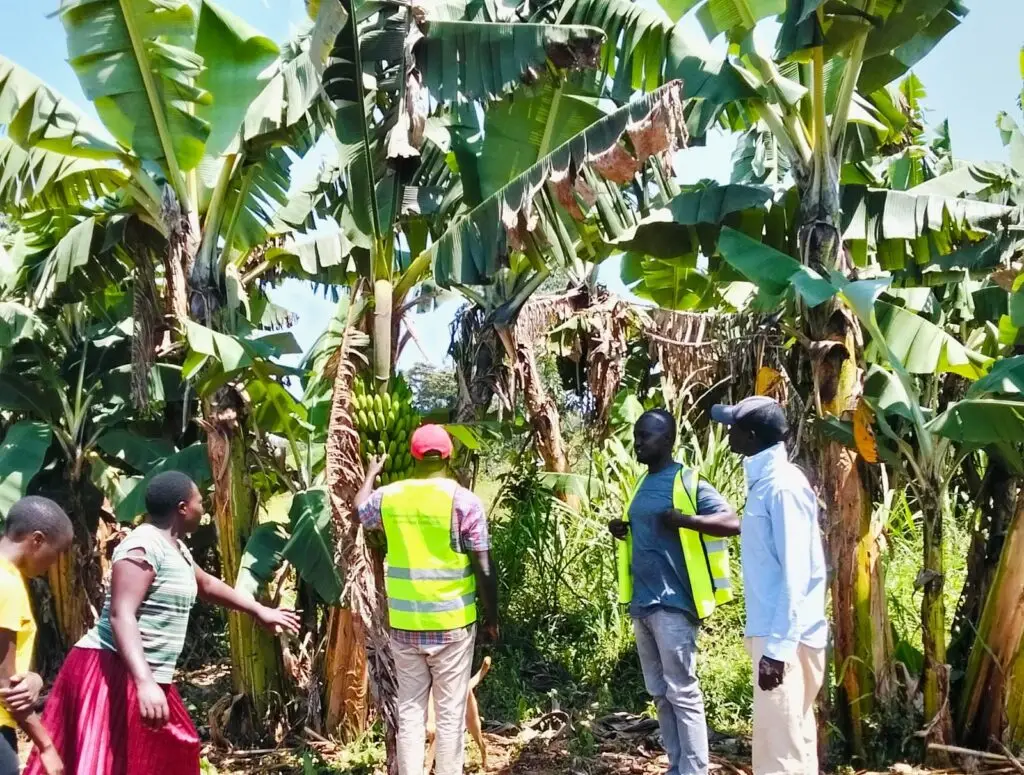
Approximately 47 million residents of East Africa rely on Lake Victoria for their livelihoods as their primary source of food, employment, and clean drinking water[1]. In Kenya, there are five counties bordering Lake Victoria – Kisumu, Siaya, Homabay, Migori, and Busia counties – with an estimated population of over 6 million residents[2]. It is estimated that less than 1% of the population is directly involved in fishing activity, while 60 – 80% of the population relies on agriculture as their main source of livelihood, making the sector critical in sustaining food security and driving sustainable reduction in poverty levels.
However, achieving food security in these regions remains a steep uphill battle. At scale, smallholder farmer (SHF) in the Great Lakes region makes between KES 50 and 300 per day, which translates to $0.34 and $2.04. Usually, these farmers grapple with a myriad of challenges, from degraded agricultural soils, financial inaccessibility to farm inputs, limited access to reliable agronomic advice, to the escalating impacts of climate change – including erratic rainfall and prolonged droughts[3],[4]. These challenges continue to limit many SHFs’ potential, as the majority can only attain 20-30% yield output of their farm’s potential under optimal conditions[5].
Development partners such as the World Bank[6] have reiterated that targeted interventions on agricultural development still hold the highest potency in reducing systemic poverty in rural Kenya, and have been shown to uplift approximately 31.4% of poor households from poverty. In fact, development interventions supporting SHFs’ access to digitized agricultural services, access to production inputs and premium markets, and strengthening institutional support systems and policies have shown remarkable socioeconomic transformation in many parts of rural Kenya.
Specifically, scaling access to digitized platforms for agricultural service provision was found to increase labor productivity and yield output by 20 – 35% respectively, which resulted in a 20 – 30% reduction in poverty rates in the intervention communities[7]. Scaling access to farm inputs through subsidies and e-voucher systems has shown a sectoral reduction in soil degradation and an increase in yield output by between 20% and 50%, contributing to an impactful reduction in poverty levels in susceptible communities, especially Arid and Semi-Arid Lands (ASALs) by up to 31%[8]. Similar positive feedback has been reported for increased access to markets and institutional support services, each contributing to a 20 – 40% increase in profitability, retention in yield and accumulated assets, and driving sectoral growth and expansion by between 20 – 30%[9].
What is FOPCO AFRICA Doing?
FOPCO Africa, a non-governmental, not-for-profit organization with operational presence in Kenya, Tanzania, Uganda, and Rwanda, has taken the initiative to empower farming communities along the Great Lakes in three countries – Kenya, Tanzania, and Uganda. FOPCO is working with on-ground partners – Community-Based Organizations (CBOs), Self Help Groups (SHGs), grassroot NGOs, and different line ministry departments – to scale impact-driven investment and growth in agriculture, education, WASH, and environmental conservation in East Africa. To achieve this, FOPCO works closely with development partners to provide digital solutions for intervention upscaling, build and upskill the capacity of local partners, and interlink local partners or end-users/beneficiaries with institutional support actors and infrastructures.
FOPCO Africa is currently coordinating grassroots training for a wide portfolio of CBOs, Cooperatives, and producer groups in priority value chains within the crop production sub-sector in the five Great Lakes counties in Kenya. The current intervention AGRO-NA-LOLWE is a capacity-building, upskilling, and sector interlinkage initiative that seeks to support youths and women farmers in the Great Lakes region to enhance resilience to climate shock, grow and profit margins by adopting sustainable production practices, and informed decision-making in agro-investment and trade. We seek to support vulnerable youths and women to competitively participate in agriculture as a profitable livelihood rather than just for hobbies or subsistence provision. To attain our goal, we are currently focusing on training and upskilling on digital agro-service solutions, soil reclamation, and linkages to institutional support infrastructure.
- Upscaling digital inclusion for informed agro-investment and trade
Our team, led by the ICT lead, Miss Alubala, has been training community focal resource persons on how to leverage the FOPCO SHAMBA[10] and FOPCOBIZ[11] – Our digital solutions tailored for farmers and agro-SMEs to enhance informed agro-investment and trade. This upskilling borrows from the TRAIN Framework,[12] where talented and respected leadership of CBOs, SHFs, line ministries departments, and lead farmers are identified, facilitated with digital devices and platforms, and trained on the utilization of these devices. FOPCO facilitates the trained partners to implement and support them in monitoring the adoption, diffusion, and impact of the solutions at the grassroots levels.
- Soil fertility conservation
FOPCO has developed an integrated module for soil fertility management and reclamation of degraded arable lands in the Great Lakes regions for farmer-facing organizations. These modules are context-based and tailored to the upskilling of community focal resource persons, offered through a blended virtual, self-paced training followed up by practical demonstration in situ. Our team has mobilized key resource personnel following the TRAIN Framework to support the adaptation of the modules to local priority needs. This training also seeks to transform the local community towards adopting agroecology-based production practices that emphasize the need to integrate regenerative production principles within the broader environmental conservative efforts. The ongoing training seeks to empower over 500 farmers facing organizations and producer groups in the five Great Lakes counties -Kisumu, Siaya, Homabay, in Kenya, by the end of 2025.
- Linkages with the Institutional Support Sector
We recognize that progressive impact on any single sector requires synergy of efforts from the different actors in the community. We do not work in silos but recognize the efforts of other actors within the community – NGOs, government departments, private sector, and national and local administrative representatives, CBOs, etc. – to foster a spirit of collaborative and transparent integration of interventions within the broader communal development initiatives. To this end, we are leveraging existing community leadership structures to advocate for transparent co-creation of intervention components, establishment of secure and open feedback loops, and shared experience as advised by our beneficiaries. We intend to onboard other partners to facilitate ease of access to agricultural credit, inputs, premium markets, certification, and incentive-based policies, etc. Specifically, we are currently keen on working closely with local credit facilities and off-takers to enrich our AI-driven end-user credit worthiness and risk assessment and agro-market information in the FOPCO SHAMBA. Additionally, we are committed to strengthening the capacity of existing community leadership structures by amplifying their voices and enhancing their visibility to advocate for community-centric interventions that are tailored to the socio-economic priorities and capacities of indigenous populations
[1] World Bank (2025). Restoring Hope: Collaborative Efforts to Save Lake Victoria. https://www.worldbank.org/en/news/feature/2025/03/18/restoring-hope-collaborative-efforts-to-save-lake-victoria
[2] Kenya National Bureau of Statistics. (2019). Population projections by county: 2020–2045. Kenya Open Data Portal. https://www.knbs.or.ke/wp-content/uploads/2023/09/2019-Kenya-population-and-Housing-Census-Summary-Report-on-Kenyas-Population-Projections.pdf
[3] Harun Gitau and Gatwiri Christine (2025). SOIL DEGRADATION | A Silent Crisis In East Africa. Heinrich-Böll-Stiftung (hbs). Accessed on September 29, 2025, fromhttps://ke.boell.org/en/2025/02/27/soil-degradation-silent-crisis-east-africa
[4] World Bank (2015). CSA Kenya: Climate‐Smart Agriculture for Kenya. Climate Knowledge Portal. Accessed on September 29, 2025, from https://climateknowledgeportal.worldbank.org/sites/default/files/2019-06/CSA%20KENYA%20NOV%2018%202015.pdf
[5] Munialo, S., Shepherd, K. D., Vlahos, V., & Gachene, C. K. (2020). Soil and management-related factors contributing to maize yield gaps in Western Kenya. Food and Energy Security. https://doi.org/10.1002/fes3.189
[6] World Bank (2019). Kenya Economic Update: Transforming Agricultural Productivity to Achieve Food Security for All. Accessed on September 29, 2025, https://www.worldbank.org/en/country/kenya/publication/kenya-economic-update-transforming-agricultural-productivity-to-achieve-food-security-for-all
[7]Ondu A. U., Cooley L., and Goh L. (2021). Digital technology and African smallholder agriculture: Implications for public policy. Brookings. Accessed on September 29, 2025, from https://www.brookings.edu/articles/digital-technology-and-african-smallholder-agriculture-implications-for-public-policy/
[8] United Nations Office for the Coordination of Humanitarian Affairs. (2023). Scaling up disruptive technologies for agricultural productivity in Kenya. ReliefWeb. Accessed on September 29, 2025, from https://reliefweb.int/report/kenya/scaling-disruptive-technologies-agricultural-productivity-kenya
[9] World Bank (2019). Kenya Economic Update: Transforming Agricultural Productivity to Achieve Food Security for All. Accessed on September 29, 2025, https://www.worldbank.org/en/country/kenya/publication/kenya-economic-update-transforming-agricultural-productivity-to-achieve-food-security-for-all
[10] FOPCO AFRICA (2025). Developing the Future: How FOPCO Africa is Using AI to Transform Smallholder Farming. Accessed on September 29, 2025, from https://fopco.org/2025/07/23/developing-the-future-how-fopco-africa-is-using-ai-to-transform-smallholder-farming/
[11] FOPCO AFRICA (2025). Empowering Kenya’s Youth and Women in Agriculture and Food & Beverage through Financial Literacy and Digital Inclusion. Accessed on September 29, 2025, from https://fopco.org/2025/08/12/empowering-kenyas-youth-and-women-in-agriculture-and-food-beverage-through-financial-literacy-and-digital-inclusion/
[12] Mormina, M.,and Pinder, S. (2018). A conceptual framework for training of trainers (ToT) interventions in global health. Global Health 14, 100. https://doi.org/10.1186/s12992-018-0420-3