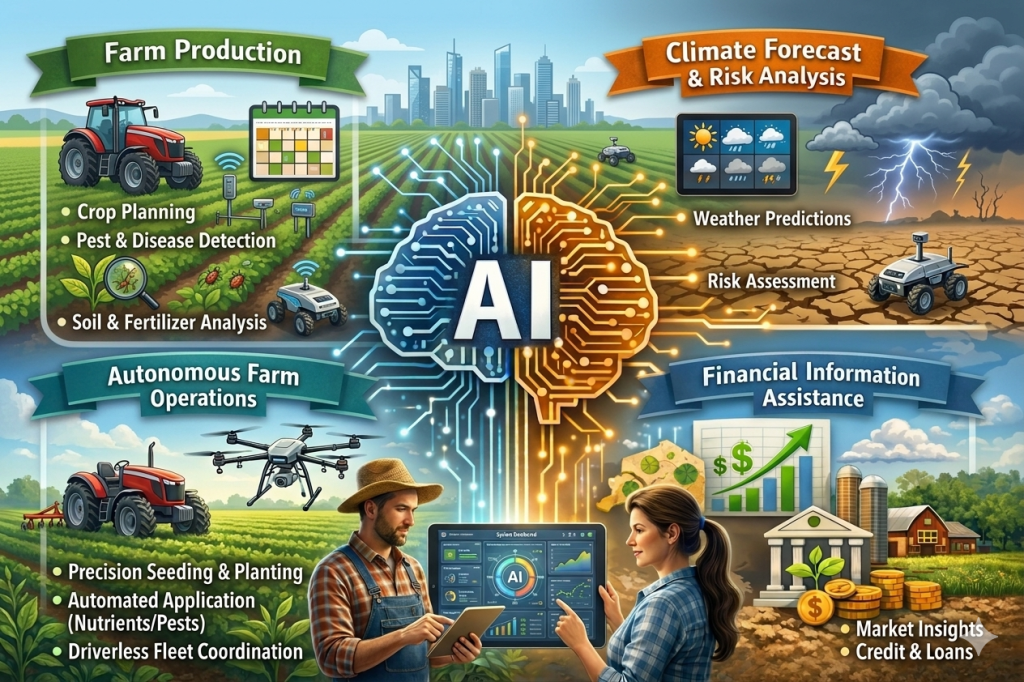
Artificial intelligence has taken over several functions across the globe from powering industries and manufacturing to undertaking simple tasks like writing resumes. Agriculture and food production, once a primary beneficiary of the industrial revolution, has not been left behind with the nascent AI revolution. Key information metrics of agriculture such as weather patterns, soil conditions, market prices, and input performance can now be predicted and conclusively determined thanks to AI intervention.
You can also leverage AI in risk assessment, especially in view of increasingly errant weather and climate patterns. AI models can combine historical climate data and current weather patterns to highlight emerging risks like drought and yield shortfalls. Consequently, you can rely on AI for decision-making using its structured support tools to make operational choices. This article captures how you can harness the ingenuity of AI across three primary areas, including farm production, climate forecast and risk analysis as well as financial information assistance.
- Farm Production
Artificial intelligence can guide key farm production activities like planting schedules, crop selection, irrigation needs, fertilizer application, and pest management. When correctly leveraged, AI can optimize input use thus increasing efficiency and improving yields by reducing risk from unpredicted events like drought stress and disease.
Here are some ideal applications of AI in farm production:
- The Farmer Crop Planner
You can develop a data-driven crop calendar by using an AI model that analyzes historical rainfall patterns, real-time weather forecasts, soil data, and specific crop growth requirements. Consequently, it can recommend the best period for planting, highlight growth stages, and determine the harvest period. The ingenuity of such a platform is that it eliminates the uncertainty of current weather patterns.
- Crop Variety Selector
Determining what to plant is a significant decision for any farmer. Some of the considerations you ponder over include input requirements, maturity period, pest tolerance and yield potential. Most farmers rely on prior experience; however, AI can integrate geo-specific data and historical performance of different crop varieties to recommend the best alternative.
- Soil Analysis
AI enables more accurate and continuous soil intelligence by combining various elements in analysis, such as sensor data, satellite imagery, historical data, and machine learning models. AI tools can generate reliable estimates of soil moisture, carbon content and nutrient availability, allowing efficient soil management and reducing water and energy costs as well as input waste.
- Fertilizer Recommender
Get fertilizer advice based in soil tests and crop type
Application of fertilizer will influence soil health, yield and overall cost. AI improves fertilizer management by offering specific site and crop requirements optimizing fertilizer placement and timing. This ensures long-term soil health, increases fertilizer efficiency, reduces input waste and improves crop yields.
- Pest Detection
Pests can render a whole cultivation useless, resulting in agonizing loss. The trick is in identifying and diagnosing the pestilence early. By examining images of crop parts and early symptoms, an AI system can analyze the visual features and compare them against an exhaustive database before diagnosing the most likely pest. This leads to early intervention and reduces unnecessary pesticide use by reducing misdiagnosis.
- Disease Detection
Like pest detection, disease detection using AI involves image analysis against a database featuring plant images with diseased and healthy crops. The AI model has the ability to recognize subtle visual nuances associated with different diseases before returning the most probable diagnosis. This fast process reduces the time between the appearance of symptoms and intervention significantly reducing misdiagnosis and thus economic losses.
- Pest and Disease Spread
Rainfall, temperature, humidity and wind conditions have a direct influence on the development of pathogens, reproduction of pest and their survival. AI systems can evaluate weather data and biological data relating to specific pests and pathogens and forecast the risk of infection or the likelihood of an increase. This allows farmers proactive control, promoting more sustainable interventions.
- Yield Protection
Avoidable losses across the production cycle hamper many a farmer’s harvest outcome. You can leverage AI in your production process by synthesizing farm and environmental datasets such as crop type, soil and weather conditions to generate specific yield projections. Such a system can also monitor in-season risks and identify yield-limiting factors early for corrective action.
- Urban Agriculture
The primary limitations of urban agriculture are limited space, higher input costs and controlled environments. With AI you can apply precision management by exhaustively analyzing environmental data and crop metrics. It can suggest crop type, appropriate farming technology, ideal conditions and resource use, improving resource efficiency.
- Climate Forecast and Risk Analysis
Agriculture is climate-sensitive, and as such, shifting seasonal patterns will disrupt productivity and thus hamper profitability. Employing AI in evaluating aspects like rainfall variability, temperature and weather extremes like droughts and floods can help reduce uncertainty by guiding operational decisions.
- Farm Advisory
AI-powered tools can interpret weather and climate alerts automatically for a particular location recommending planting windows, flagging pest and disease risk, and recommending irrigation schedules. You can get alerts through mobile applications or SMS notifications. By implementing AI-enabled farm production, you benefit from better resource use and reduced losses.
- Yearly Climate Overview.
A year-long climate overview can help farmers plan strategically, especially in terms of resource allocation. When you use AI, the accuracy of the review is significantly improved, as it can analyze climate data sets over a long period for more elaborate outcomes. Such climate data can be retrieved from NASA’s satellite archives.
- Financial Information Assistance
Artificial intelligence can analyze market data and farm records to provide practical financial insights, making it a key decision-support engine. AI-generated financial assistance offers you a more data-driven scope in business management, reducing information gaps. Consequently, it enables improved budgeting and makes for better cash-flow planning, cost tracking, and forecasting of revenue.
- Market Intelligence
Agricultural markets are influenced by various factors like weather, demand and supply, and logistics. AI systems can analyze these variables and generate actionable forecasts and insights by using varied datasets like historical prices, production cycles and weather projections. The outcome is an optimal production process with reduced cost and enhanced productivity.
- Financial Access and Risk
Many farmers and agri-based SMEs identify financial access as a major constraint. Lenders consider farm production a high risk investment owing to factors like weather and climate shifts as well as pests and diseases that result in fluctuating incomes. Implementing AI in risk assessment offers more precise and custom insights.
AI integrates farm production data, accounting records, transaction histories and market signals, improving the lender’s confidence. In turn, it enhances the farmer’s visibility as a borrower by reducing information asymmetry. As a result, AI allows for better-aligned financial products and more accurate credit decisions.
Conclusion
AI transforms raw farm data from sources such as satellite imagery and weather feeds before applying them to different aspects like soil tests, sensor readings and yield records to provide tailored insights that reflect crop types, local conditions and operational realities. Using AI-powered analysis of weather forecasts, soil moisture levels, and crop growth stages, you can determine production-related decisions such as the best time to plant, when and how to irrigate, when to apply fertilizer and how much, as well as how to combat pests. The result is a marked improvement in productivity and efficiency.